

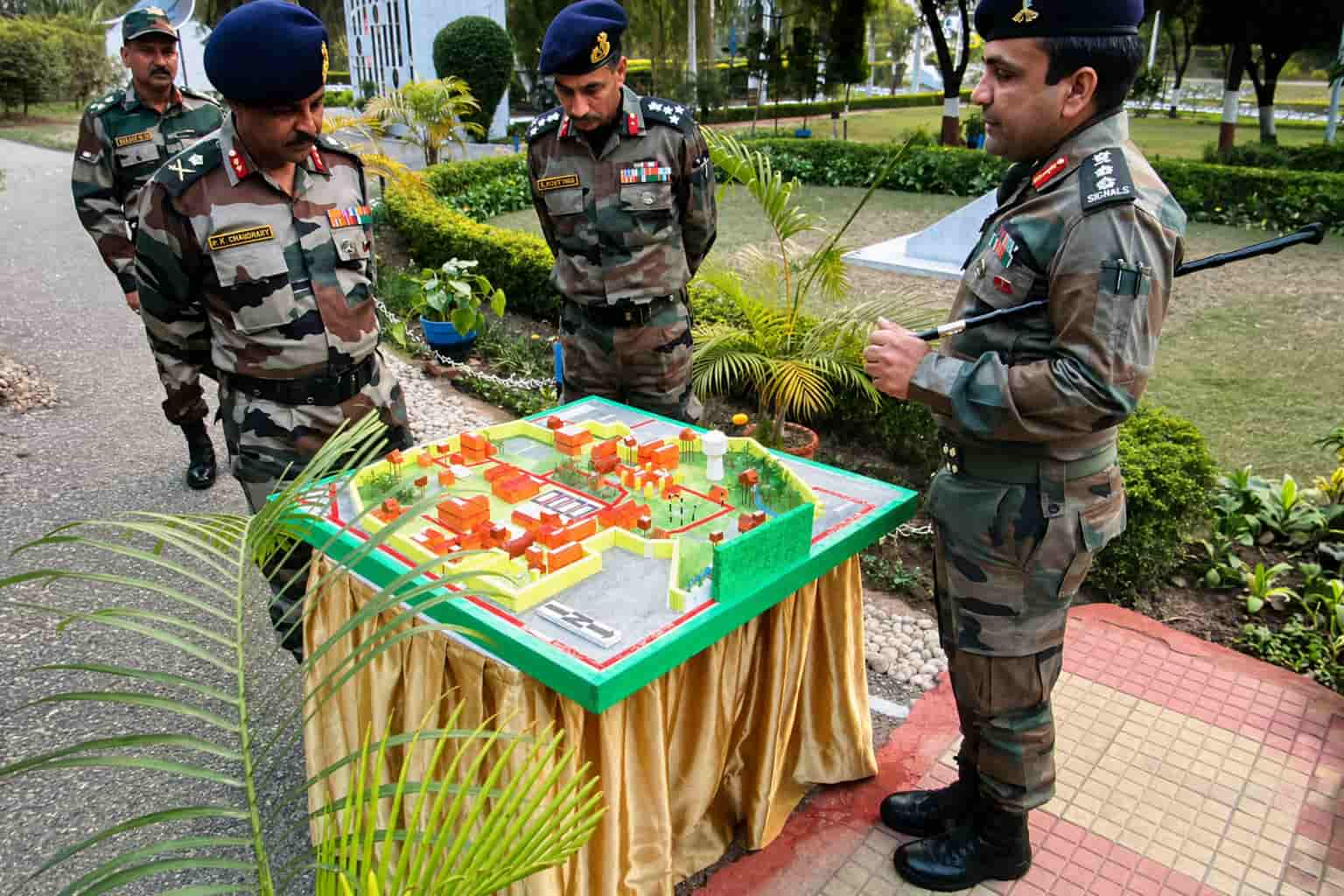
The future of warfare will not be decided only by the size of armies, the number of tanks, or the range of missiles. These things will remain important, but the real battlefield advantage is shifting toward something faster and deeper: the ability to collect information, understand it correctly, and convert it into timely decisions. This is the central idea that comes through in the conversation with Maj Gen Ravi Kumar Chaudhary (Retd), VSM on Sainik Welfare News Cast.
In this episode, Maj Gen Chaudhary brings a rare combination of experiences. He speaks not only as a soldier who has seen Army life from close quarters, but also as someone who has understood the world of intelligence, technology, data, indigenisation and national security systems. That is why his perspective stands out. He is not looking at defence technology as a fashionable buzzword. He is looking at it as a practical tool that must help the commander on ground.
The most important point in the discussion is the shift from information superiority to decision superiority. In earlier years, having more information itself was considered a major advantage. If a force knew more about the enemy’s movement, location, strength or intention, it had an edge. But today the situation is different. Data is coming from everywhere: satellites, drones, sensors, surveillance systems, communication intercepts, open-source platforms and field inputs. The challenge is no longer only to collect data. The challenge is to make sense of it quickly.
This is where Maj Gen Chaudhary’s idea of a “decision fabric” becomes important. He explains that scattered threads do not become fabric on their own. They have to be organised, woven and strengthened into something useful. In the same way, raw data does not automatically become intelligence. It has to be filtered, structured, analysed and presented in a way that helps decision-makers act with confidence. This simple explanation makes a complex defence technology issue easy to understand.
For the Indian Armed Forces, this idea is extremely relevant. Modern warfare is becoming faster, more connected and more technology-driven. A commander may receive multiple inputs at the same time, but if those inputs are not organised properly, they can create confusion instead of clarity. A dashboard full of information is not enough. A system must tell the commander what matters, what is urgent, what is reliable and what action may be needed next. That is the difference between data display and decision support.
The podcast also connects this thinking with the larger debate on artificial intelligence in defence. AI is often presented as a magic solution, but Maj Gen Chaudhary’s view appears more grounded. AI should not be treated as decoration or a dashboard feature. It must solve real military problems. It must reduce delays, improve analysis, support commanders and help the system identify patterns that may not be visible through manual methods alone. In simple terms, AI in defence must move from presentation to performance.

Another powerful part of the conversation is the discussion on indigenisation. India cannot build future military strength only by importing platforms, tools and systems. Strategic autonomy requires domestic capability. This does not mean everything can be built overnight, but it does mean the direction must be clear. If India is serious about future wars, it must invest not only in weapons but also in data systems, analytics tools, secure networks, indigenous sensors and skilled human resources. Capture of data is important, but analysis of data is equally important.
The episode also touches upon Agnipath in a balanced manner. Maj Gen Chaudhary explains the operational logic behind a younger force profile, better trainability and the need to manage the teeth-to-tail ratio. A younger force can bring energy, adaptability and faster absorption of training. At the same time, he also makes an important welfare point: national policy must protect the dignity of martyrs’ families and strengthen meaningful disability support for those injured in service. This balance is important because defence reform cannot be judged only through manpower numbers. It must also be judged through fairness, honour and long-term support.
One of the strongest takeaways from the podcast is his emphasis on problem-solving. Many reforms fail because systems treat symptoms as the problem. A file may be delayed, a project may not move, or a technology may not be used properly. But the real issue may be deeper: unclear ownership, weak data structure, poor user design, fragmented responsibility or lack of feedback from the ground. Maj Gen Chaudhary’s message is that serious reform begins only when we define the real problem correctly.
This is especially important for defence modernisation. India has created several reform structures over the years, including discussions around jointness, integration, civil-military coordination and technology adoption. But implementation often becomes the real test. A policy may look strong on paper, but if the user on ground does not get a usable system, the reform remains incomplete. That is why technology must be designed with the soldier, commander and operational environment in mind.
The conversation also carries an important lesson for aspirants, young officers and professionals who want to contribute to national security. The key is not merely to admire technology. The key is to learn continuously, write clearly, understand the problem and build practical solutions. In future warfare, the best minds will not be those who only know theory. They will be those who can connect soldiering, technology, intelligence and decision-making.
Maj Gen Ravi Kumar Chaudhary’s perspective is valuable because it does not exaggerate technology and does not reject traditional soldiering. Instead, it connects both. The soldier’s mindset still matters. Courage, discipline, adaptability and mission focus still matter. But these qualities now need to work with data, AI, analytics and digital systems. The battlefield is changing, and the military mind must change with it.
For India, the message is clear. Future wars will demand faster understanding, stronger indigenous systems and better decision support. The country must move beyond collecting information and focus on converting information into action. The winning edge will come from those who can build systems where data, intelligence, leadership and technology come together.
That is why this podcast is more than a discussion on AI or Agnipath. It is a deeper conversation on how India should think about future warfare. The big question is not whether technology will enter the battlefield. It already has. The real question is whether India can build the decision fabric needed to use it better, faster and with greater strategic clarity.


Leave a Reply