

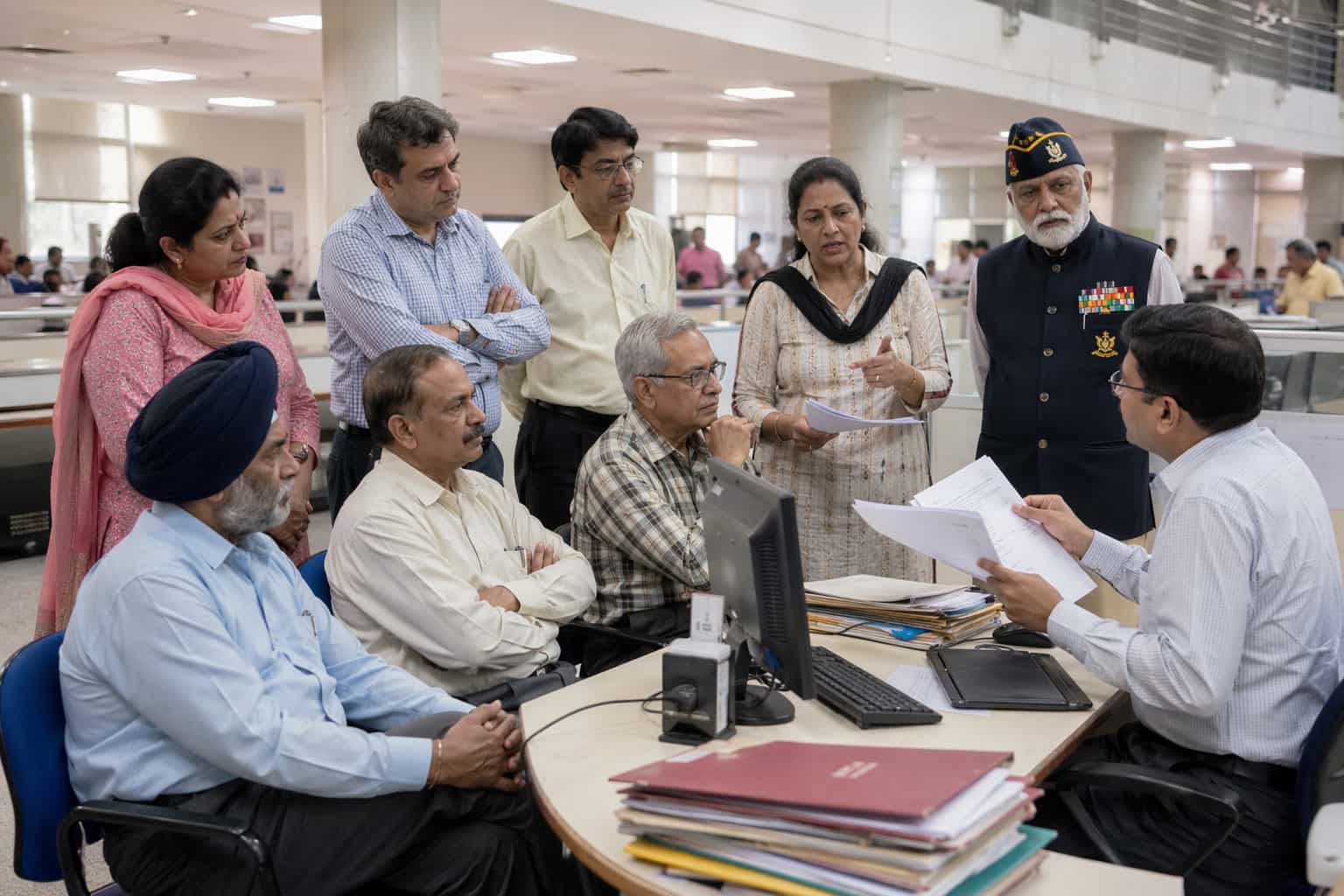
For central government employees and pensioners, the biggest issue is often not only the amount of a future revision, but the certainty of the process itself. That is why the question raised in Parliament about the absence of a clear date for the 8th Central Pay Commission mattered so much. It reflected a simple public concern: if the next pay revision cycle is approaching, why is there still no formal clarity, and how long are employees and pensioners expected to wait? That anxiety was visible in Parliament well before the Commission’s later formal steps were completed. In a Lok Sabha reply dated 22 July 2024, the Ministry of Finance said two representations had been received in June 2024 for constitution of the 8th Central Pay Commission, but added that no such proposal was under consideration at that time.
That one reply carried more weight than it seemed. It was not just a technical answer to a parliamentary question. It effectively told lakhs of employees and pensioners that the government had received the demand, but had not yet committed to a formal timeline. For people whose salaries, pensions, family pension expectations, and long-term financial planning depend on pay revision cycles, that kind of uncertainty naturally creates concern. The reason is straightforward. Pay commissions are not ordinary announcements. They affect basic pay, allowances, retirement benefits, and the larger structure through which the Centre evaluates compensation across categories of service. When the question becomes “why no date?”, it is really a question about predictability, trust, and administrative intent.
The background to this concern was already built into the system. In its later Terms of Reference note, the government itself acknowledged that pay commissions are usually constituted periodically and that, going by the normal ten-year trend, the effect of the 8th Central Pay Commission recommendations would ordinarily be expected from 1 January 2026. The same official note also records that the government had announced the formation of the 8th Central Pay Commission in January 2025. In other words, the timeline question did not come out of nowhere. Employees and pensioners were watching the calendar, looking at the conventional cycle, and asking why formal movement had not come earlier. That is what gave the parliamentary question its real force. It was expressing a concern many people already had.
What changed later is equally important. On 28 October 2025, the Union Cabinet approved the Terms of Reference of the 8th Central Pay Commission. The official PIB release stated that the Commission would be a temporary body with a chairperson, one part-time member, and a member-secretary, and that it would make its recommendations within 18 months of its constitution. The same release also clarified that the Commission would keep in view economic conditions, fiscal prudence, developmental needs, pension liabilities, the impact on state finances, and the prevailing emolument structure in public and private sectors. This means the government eventually moved from uncertainty to formal structure, but it also confirmed that the process would not be immediate. Once an 18-month recommendation window is built into the framework, the debate shifts from “will it be formed?” to “when will the actual benefits be seen?”
That distinction is crucial for readers. Formation of a pay commission and implementation of its benefits are not the same thing. The official framework shows that the 8th CPC has a substantial consultation and recommendation period. By early 2026, the process had already moved into structured public consultation. The official MyGov questionnaire for the 8th Central Pay Commission opened on 5 February 2026, and the Commission’s official site stated that responses had to be submitted through the MyGov portal, with paper submissions, emails, or PDF responses not being considered. The deadline was extended up to 31 March 2026. This tells us two things. First, the government did move into an active consultation stage. Second, the Commission is not operating as a quick headline-based exercise, but as a slower formal mechanism that gathers input before recommendations are framed.

This is exactly why the earlier “why no date?” question still matters even after formation. It captured a deeper fear that many employees and pensioners continue to have: delay at the front end can push uncertainty into the next stage as well. Once the process begins late, every later step becomes more closely watched. People start asking whether the recommendations will arrive on time, whether implementation will be backdated, whether arrears will become an issue, and whether categories like pensioners, family pensioners, and hardship-affected retirees will get fair treatment. The anxiety is not only about salaries going up. It is about whether the state will provide enough clarity for families to plan their finances with confidence.
For the defence and veterans community, this concern becomes even sharper. Ex-servicemen and defence pensioners do not look at the pay commission as a purely civil-service event. They read it through the lens of pension fairness, old anomalies, parity questions, family security, and how rank-based realities are treated over time. Even where a pay commission is not the sole solution to every defence pension issue, it still influences the broader conversation around financial dignity in retirement. That is why questions about date, structure, and implementation matter so much in the veterans space. A delay is never seen as just a bureaucratic delay. It is seen as a delay in clarity for households that depend on timely decisions.
There is also a political lesson here. Parliamentary questions often look small in the moment, but they can reveal the emotional temperature of a much larger constituency. When lawmakers pressed for clarity on timing, they were effectively voicing the worry of employees and pensioners who felt the next revision cycle was approaching but the official machinery was still moving too slowly. Later developments proved that the issue was live, serious, and impossible to ignore. The government did announce the formation in January 2025, later approved the Terms of Reference in October 2025, and moved into formal consultation in early 2026. But the fact remains that the original concern was not misplaced. The question had been raised because uncertainty was real.
So the real story here is not just that Parliament once asked why there was still no date for the 8th Pay Commission. The bigger story is that the question captured the exact mood of the community before official movement picked up. It exposed how deeply employees and pensioners value clarity, not just eventual revision. It also reminded everyone that timing matters almost as much as the final numbers. A pay commission is not only about what the government will recommend. It is also about when the process begins, how transparently it moves, and whether people feel seen while they wait. That is why this issue remains so relevant even now. The question “why no date?” was never a small one. It was the first clear signal of a larger trust deficit that the 8th CPC process now has to answer.



Leave a Reply