

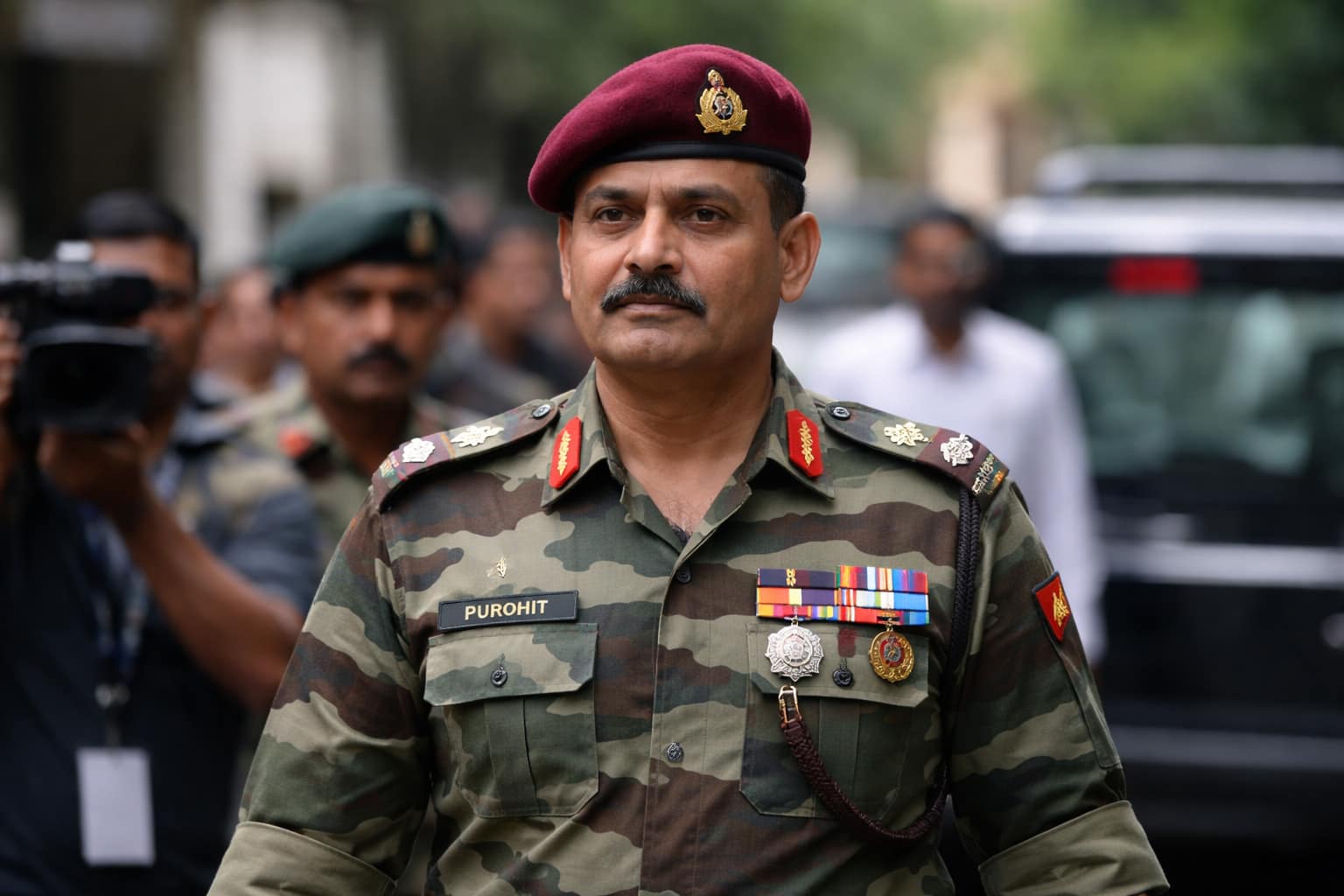
The Colonel Shrikant Purohit case has once again returned to public discussion, not only because of the Malegaon blast verdict, but because of what followed inside the military system. After nearly 17 years of legal proceedings, Colonel Prasad Shrikant Purohit was acquitted by a Special NIA court in the 2008 Malegaon blast case. Now, reports say the Indian Army has cleared him for promotion to the rank of Brigadier, turning a long and controversial legal battle into a major debate on justice, service rights and accountability.
The story is emotional for many veterans because it sits at the intersection of three sensitive issues: terrorism investigation, military intelligence work and the career of a serving Army officer. But before forming any opinion, it is important to separate claims, allegations, court findings and official service decisions.
The 2008 Malegaon blast took place on September 29, 2008, when an explosive device went off in Malegaon, Maharashtra. Six people were killed and many others were injured. The case was first investigated by the Maharashtra Anti-Terrorism Squad and was later transferred to the National Investigation Agency in 2011. Colonel Purohit, then associated with military intelligence, became one of the accused in the case.
For years, the case remained one of India’s most debated terror trials. It was not just a criminal case. It became a national conversation about investigative standards, political narratives, intelligence operations and the rights of accused persons. Purohit spent years in custody, was released on bail in 2017, and the case continued until the final verdict in 2025.
The major turning point came on July 31, 2025, when the Special NIA court acquitted all seven accused, including Purohit. Reports on the verdict stated that the court found that the prosecution failed to establish the charges beyond reasonable doubt. Some reports also noted concerns around sanction issues, investigation lapses and forensic gaps.

This is where public debate becomes complicated. Acquittal does not erase the tragedy of Malegaon. The victims and their families still deserve justice, answers and closure. At the same time, in any constitutional democracy, if a person is tried for years and the court does not find the evidence sufficient to convict, the legal system must also protect that person’s rights and reputation.
After the acquittal, the question moved from criminal court to service career. Purohit approached the Armed Forces Tribunal, arguing that the long trial had affected his career progression. The AFT order dated March 16, 2026 recorded that he claimed entitlement to promotion to Colonel and thereafter Brigadier at par with his juniors. The Tribunal directed that his retirement should be kept in abeyance until a decision was taken on his statutory complaint.
This AFT order is important because it shows the service-side issue clearly. If an officer’s promotion was held back because of a criminal case, and that officer is later acquitted, should his career be reconsidered? Should he get the same opportunity that his batchmates or juniors received? Or should the system treat the lost years as an unfortunate consequence of legal proceedings? These are not easy questions, but they matter deeply for uniformed personnel.
Reports now say that the Army has cleared Colonel Purohit for promotion to Brigadier. ThePrint reported that this would allow him to continue serving for at least two more years, as the retirement age for Brigadier is higher than that of Colonel. Hindustan Times also reported that he had approached the AFT on the ground that the long trial affected his career progression.
For the fauji community, this development is being seen by many as more than a promotion. It is being read as a form of institutional correction after a long legal battle. However, the matter should still be discussed with caution. The correct position is not to declare anyone guilty by public opinion, nor to ignore the seriousness of the blast case. The correct position is to respect the court record, examine the investigation process and ask whether better safeguards are needed in sensitive cases involving serving personnel.
The description also refers to public claims about intelligence inputs, covert work and a so-called TET setup. Such claims may be part of public commentary, interviews or media discussions, but they should not be presented as final fact unless supported by official documents or court records. In a responsible blog, it is safer to say: “The clip claims…” or “The discussion alleges…” instead of stating those claims as proven facts.
The bigger question is accountability. If a serving officer spends years under serious charges and is later acquitted, who reviews the damage to his career? If an investigation has gaps, who studies those gaps so they are not repeated? If intelligence work requires secrecy, how should the system protect genuine covert operators while still allowing lawful investigation? These questions go beyond one officer and one case.
This case also teaches viewers and readers one important lesson: national security stories should never be consumed only through emotion. A viral clip can raise important questions, but final understanding must come from court orders, official documents and credible reporting. In cases involving terrorism, Army service and public trust, every word matters.
For veterans, serving personnel and defence families, the Purohit case will remain a powerful example of how long legal proceedings can affect a military career. For the justice system, it raises questions about investigation quality and trial delay. For the public, it is a reminder that allegations, charges, trial, acquittal and service benefits are different stages, and each must be understood separately.
The latest development is therefore not just about one officer becoming Brigadier. It is about a larger debate: how India should balance national security, fair trial, institutional accountability and the dignity of those who serve in uniform. That is why this story is still being discussed, and why it deserves a careful, fact-based conversation rather than only emotional reactions.


Leave a Reply