

In the early 1990s, India was navigating a period of geopolitical uncertainty and technological transition. The Cold War had just ended, the Soviet Union had collapsed, and long-standing defence supply chains were suddenly disrupted. For the Indian Army, this was not just a strategic concern, it was an immediate operational challenge.
Amid this backdrop emerged a remarkable story of innovation, leadership, and problem-solving. It is a story that connects a young infantry Major, a critical battlefield requirement, and one of India’s greatest scientific minds, Dr APJ Abdul Kalam.
This is not just a story about technology. It is about how real innovation begins on the ground, with the soldier.
The bigger vision: Modernising the infantry soldier
Before diving into the incident itself, it is important to understand the larger vision shaping the Indian Army at the time. The concept of F-INSAS, or Future Infantry Soldier as a System, was being explored as a long-term approach to modernisation.
The idea was simple but transformative. An infantry soldier should not operate as an isolated unit but as part of an integrated system. This meant equipping soldiers with advanced weapons, better protection like bulletproof jackets and helmets, reliable communication systems, night vision devices, and enhanced situational awareness.
The goal was to create a soldier who was fully connected to the battlefield environment, capable of faster decision-making and improved combat effectiveness.
The crisis: When supply chains broke down
In 1991, a serious problem emerged. The Indian Army had a considerable number of Fagot anti-tank missile launchers in its inventory. However, with the collapse of the Soviet Union, the supply of Fagot missiles was disrupted.
This created a dangerous gap. The launchers were available, but the missiles required to operate them were not. At the same time, India had access to MILAN missiles through other channels and growing indigenous capabilities.
The question that arose was both practical and urgent: could an existing Fagot launcher be adapted to fire a MILAN missile?
At first glance, this seemed like a technical mismatch. These systems were designed independently, with different specifications and operational frameworks. But on the battlefield, the luxury of waiting for perfect compatibility does not exist. What matters is functionality.
The turning point: A visit to DRDO
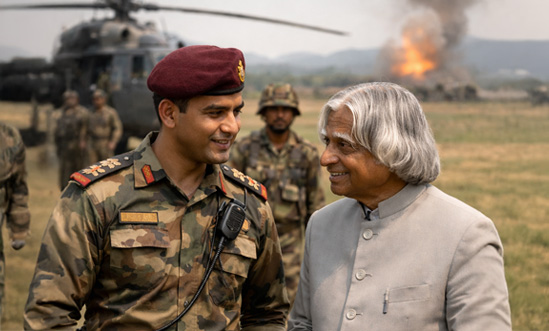
During this period, a young Major Ajay Ohri visited a DRDO laboratory in Hyderabad. He carried with him not just a question, but a real operational requirement.
What followed is what makes this story truly extraordinary.
Dr APJ Abdul Kalam, already a respected figure in India’s missile and defence research ecosystem, personally engaged with the problem. Instead of approaching it as a theoretical or bureaucratic issue, he did something rare. He listened.
According to Maj Gen Ajay Ohri, Dr Kalam’s approach was grounded and direct. His focus was not on hierarchy or process, but on understanding the user’s requirement. He reportedly said that he had come to hear the problem from the soldier’s perspective.
This moment reflects a powerful leadership principle. Innovation is most effective when it begins with the end user.
The solution: FLAME
The outcome of this interaction was a solution that would later be known as FLAME, short for Fagot Launcher Adapted to Milan Equipment.
The concept was straightforward in intent but significant in impact. By adapting the existing Fagot launchers to fire MILAN missiles, the Army could continue to use its available equipment effectively without waiting for new systems or discarding valuable assets.
This was not just a technical fix. It was a strategic solution.
The FLAME adaptation ensured that existing inventory did not become obsolete. It extended the operational life of critical equipment and allowed the Army to maintain readiness despite supply disruptions.
In defence terms, this was value addition at scale.
Why this innovation matters?
At one level, FLAME solved a specific compatibility issue. But its significance goes far beyond that.
First, it demonstrated the importance of flexibility in military systems. Rigid, siloed systems can become liabilities in times of crisis. Adaptable systems, on the other hand, provide resilience.
Second, it highlighted the role of indigenous innovation. Instead of depending entirely on external suppliers, India found a way to create a solution within its own ecosystem. This aligns with today’s emphasis on self-reliance in defence production.
Third, it reinforced the idea that innovation does not always require new inventions. Sometimes, it is about reimagining and repurposing what already exists.

Dr Kalam’s leadership style
One of the most striking aspects of this story is Dr Kalam’s approach to problem-solving.
He did not treat the issue as a distant technical challenge. He engaged with it at a human level, focusing on the needs of the soldier who would ultimately use the system.
His willingness to listen, his openness to unconventional solutions, and his commitment to delivering results made a lasting impact.
This is perhaps why he is remembered not just as a scientist, but as a leader who inspired trust across institutions.
Lessons for India’s defence ecosystem
The FLAME story offers several important lessons that remain relevant even today.
Innovation must begin with real user problems, not theoretical models. Soldiers on the ground often have the clearest understanding of what works and what does not.
Collaboration between the military and research organisations is essential. When these two worlds align, solutions become faster and more effective.
Resource optimisation is as important as new procurement. In a country with vast defence requirements, making the best use of existing assets can significantly enhance capability.
Most importantly, leadership matters. When leaders prioritise solutions over processes, progress becomes inevitable.
Conclusion
The meeting between a young Army Major and Dr APJ Abdul Kalam in 1991 may have seemed like a small moment at the time. But its outcome, the FLAME innovation, had a lasting impact on operational capability.
It is a reminder that behind every major advancement, there is often a simple question asked at the right time, by the right person.
In today’s era of advanced technology and modern warfare, the essence of innovation remains unchanged. It starts with a problem, it grows through collaboration, and it succeeds when it serves the people who need it the most.
Watch our full video for complete details!


Leave a Reply