

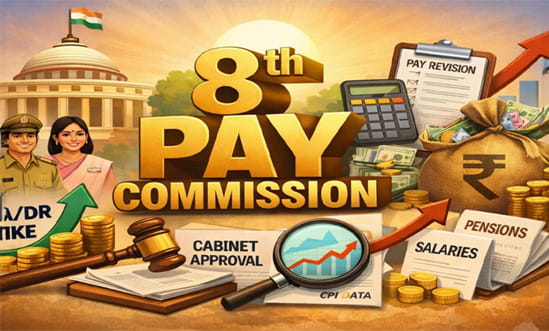
The 8th Pay Commission has once again become a major talking point among central government employees and pensioners. This time, the focus is on a fresh demand charter reportedly placed by the NCJCM draft committee. While these proposals are not the final recommendations of the Commission, they offer an important glimpse into what employee-side representatives want the government to consider.
At the centre of this discussion are some headline-grabbing demands: a proposed minimum pay of Rs 69,000, an annual increment of 6 percent, pension at 67 percent of last pay drawn, family pension at 50 percent, HRA up to 40 percent, and a restructuring of the current pay matrix from 18 levels to just 7 merged levels.
Naturally, these demands have created excitement. But they also raise questions. How realistic are they? Which proposals could benefit employees and pensioners the most? And what would a 7-level structure mean for the present pay system?
Why this demand charter matters?
Every Pay Commission process involves inputs from multiple stakeholders. These include employee federations, unions, pensioner groups, and other representative bodies. The draft committee’s 21-point charter is important because it shows the issues that are being pushed most strongly from the employees’ side.
This does not mean that every demand will be accepted. However, such documents often influence the tone of the larger debate and highlight the areas where there is deep dissatisfaction with the current system.
In simple terms, this charter is not the final verdict, but it is a strong signal.
The biggest demands in the spotlight.
One of the most discussed proposals is the minimum pay of Rs 69,000, reportedly calculated using a family-of-five standard. If accepted in any form, this would mark a major shift from the present structure and would have a cascading impact across pay levels.
Another major proposal is the fitment factor of 3.833 for both serving employees and pensioners. This number matters because fitment is the multiplier that helps convert existing pay into revised pay under a new commission. Even a small change in this factor can make a huge difference to salaries and pensions.
The draft also calls for implementation from January 2026, which is significant because timing affects not just future salaries, but also the possibility of arrears and revised pension calculations.
Pension-related proposals could draw the most attention.
For pensioners, some of the most striking demands are related to retirement benefits. The draft reportedly seeks pension at 67 percent of last pay drawn and family pension at 50 percent. If these ideas move forward, they could become among the most debated issues of the 8th CPC process.
There is also a strong push on the long-standing issue of commutation restoration. The demand is for restoration after 11 years instead of 15 years, a proposal that will likely resonate deeply with pensioners who have repeatedly argued that the present restoration period is too long.
Another politically sensitive demand is the restoration of the Old Pension Scheme for those who joined service after 1 January 2004. This reflects the continuing dissatisfaction with NPS and the wider pension debate that remains active across the country. The inclusion of OPS, along with conversations around UPS and NPS, shows that pension reform remains one of the most emotionally charged parts of the entire 8th Pay Commission discussion.
More money, more mobility, more benefits
The draft also appears to focus on service progression and employee welfare. One important proposal is 5 financial upgradations under MACP within 30 years, which would be welcomed by many employees who feel that career progression remains too slow under the current structure.
The suggested annual increment of 6 percent, against the current 3 percent, would also be seen as a major improvement if taken seriously. Over a full career, this difference could significantly affect both salary growth and eventual pension.
On the benefits side, the charter reportedly asks for:
- HRA at 40 percent for X class cities, 35 percent for Y, and 30 percent for Z
- Leave encashment ceiling to rise from 300 to 600 days
- Paternity leave of 45 days
- Parents care leave of 60 days during entire service
- Maternity leave of 240 days without the two-child restriction
- Bonus of minimum 30 days based on actual basic pay plus DA
- Higher insurance and death compensation benefits
- Gratuity with no ceiling, linked to one month’s wages up to 33 years
Taken together, these proposals show that the draft is not limited to salary revision alone. It is trying to address a wider set of concerns involving family support, retirement security, compensation, and work-life balance.
The 18-to-7 pay level proposal is the boldest structural idea.
Perhaps the most unusual proposal in the charter is the plan to reduce the current 18 pay levels into 7 merged levels. This would amount to a major redesign of the pay matrix.
The argument in favour of such a move may be simplicity, better grouping, and reduced fragmentation in the structure. But such a change could also produce fresh anomalies. Whenever different levels are merged, questions arise about seniority, promotional value, pay compression, and fairness between categories.
So while the idea sounds bold and reform-oriented, it would require careful examination before it could ever move beyond the proposal stage.
What employees and pensioners should keep in mind?
At this stage, the most important thing to remember is this: these are demands, not final recommendations. The 8th Pay Commission has not yet issued its conclusions, and the government has not approved these proposals.
Still, the draft matters because it reflects the expectations of a large section of employees and pensioners. It tells us where the pressure points are likely to be in the coming months: minimum pay, fitment factor, pension formula, OPS debate, HRA revision, MACP reform, and commutation relief.
The latest 8th Pay Commission discussion has gone beyond routine salary revision talk. The NCJCM draft committee’s reported 21 demands show that the debate is now expanding into pensions, promotions, allowances, family benefits, and structural reform of the pay matrix itself.
Some demands may appear ambitious. Others may seem difficult to implement in full. But together, they reflect one clear message: employees and pensioners want a more meaningful and comprehensive revision, not just a cosmetic update.
For now, the demand charter should be seen as an important starting point, not the final destination. The real outcome will depend on what the Commission examines, what it recommends, and what the government eventually accepts. Until then, this remains one of the most closely watched developments for central government employees and pensioners across India.
Watch our full video for complete details!


Leave a Reply