

The delay in announcing the January 2026 Dearness Allowance and Dearness Relief revision has become a major talking point among central government employees and pensioners. What is usually treated as a routine financial update has now turned into a source of uncertainty, discussion, and growing frustration.
For many families, DA and DR are not just technical government terms. They directly affect monthly budgeting, household expenses, and financial planning. That is why the continued wait for the January 2026 instalment is drawing so much attention.
What is still pending?
At the centre of the issue is the DA and DR instalment effective from 1 January 2026. Employees and pensioners are still waiting for the formal notification that would confirm the revised rate. Along with this, there is also anticipation around arrears, which are generally paid after the official order is issued.
In normal circumstances, such revisions are typically announced around late March, and the dues are processed soon after. This year, however, April has advanced without a formal declaration, and that unusual delay has triggered concern across employee and pensioner circles.
Why this delay matters?
A delay in DA or DR is not just about waiting for a percentage increase on paper. It has a real impact on people’s day-to-day financial planning. Many government employees and pensioners structure their expenses based on expected revisions in pay and relief. When an announcement takes longer than usual, uncertainty begins to affect decisions related to savings, household spending, and upcoming commitments.
This is exactly why the current situation is being followed so closely. The concern is not only about the money involved, but also about the lack of clarity.
Employee body announces protest!
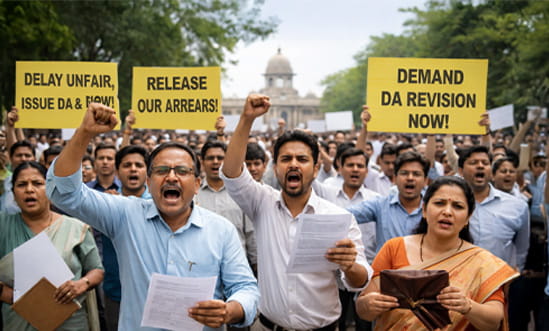
According to the details discussed in the update, an employee body has announced a protest on 16 April over the continued delay in notifying the January 2026 DA and DR instalment. This development has given the issue a wider public dimension.
The protest is reportedly linked to the frustration building among employees who feel that a routine revision should not remain pending for so long. Several departments are said to be associated with the protest call, including Income Tax, Postal, Agriculture, Botanical Survey of India, Geological Survey of India, and Survey of India.
The core demand appears straightforward: issue the DA and DR notification and release the arrears so that employees and pensioners are not left waiting any longer.
Why “freeze” concerns are spreading again?
One of the biggest reasons behind the growing anxiety is the memory of the Covid period, when DA and DR were frozen for an extended duration. Because the current delay is longer than usual, some employees are beginning to worry whether history could repeat itself.
At present, however, the key point is this: there is a delay, but speculation should not be confused with official confirmation. Concerns may be growing, but any final position on DA or DR becomes valid only after the government formally clears it.
That distinction is important. In situations like this, rumours spread quickly. Employees and pensioners should focus on verified updates rather than assumptions circulating in groups and informal discussions.
What will count as official confirmation?
No matter how many reports or discussions emerge, the DA and DR revision becomes final only when it is formally approved and notified by the government.
There are two main signals people should watch for:
First, Cabinet approval.
Second, a formal order or notification issued through official government channels.
Until those steps are completed, the matter remains pending, regardless of what is being predicted or expected.
What employees and pensioners should track now?
Instead of relying on rumours, employees and pensioners should keep an eye on official platforms where such updates are normally reflected. These include the Department of Expenditure’s DA orders page and the Pensioners’ Portal for DR-related updates.
These sources are important because they provide the actual government position, not assumptions based on discussion. Anyone waiting for the revised rate or arrears should verify the update only after the formal order appears.
A developing issue, not a final decision.
The present situation should be understood for what it is: a delay that has now become serious enough to trigger public reaction. It is not yet a confirmed case of any freeze or policy shift. At the same time, it is also no longer something employees and pensioners are treating as a routine wait.
That is why the next few official developments will matter greatly. Whether the government moves quickly to notify the revision or the delay continues further will shape the mood among employees and pensioners in the coming days.
The pending January 2026 DA and DR revision has become more than just an administrative delay. It has turned into an issue of trust, timing, and financial certainty for lakhs of employees and pensioners. With a protest now entering the picture, the pressure for official clarity is clearly increasing.
For now, the most sensible approach is to stay alert, follow only verified government sources, and separate confirmed facts from speculation. The final decision will matter not just because of the increase itself, but because it will bring much-needed clarity to millions waiting for an answer.
Watch our full video for complete details!




Leave a Reply