

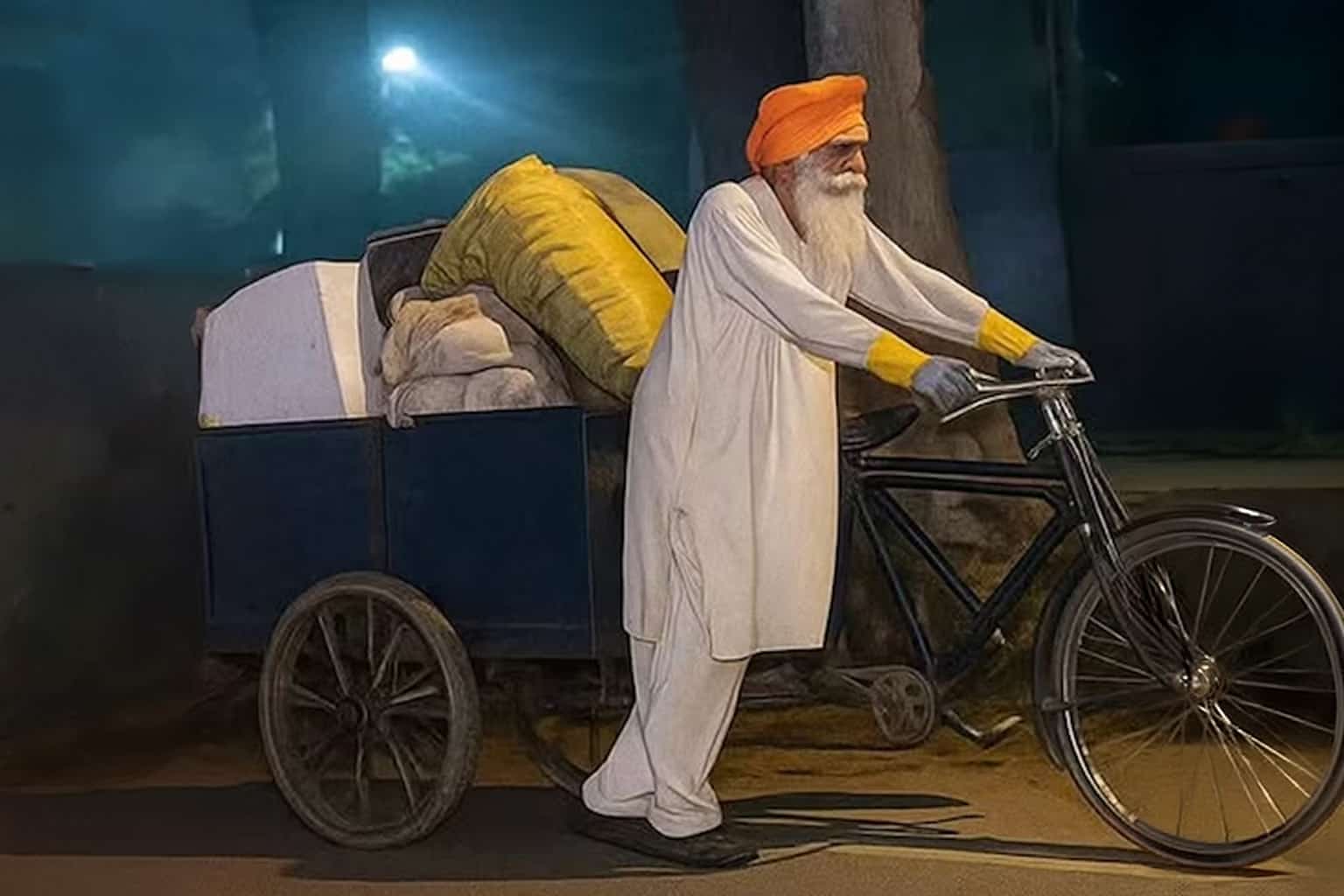
There are people who retire from office. Then there are people who continue serving even after the office has disappeared from their daily life.
Inderjit Singh Sidhu belongs to the second category.
His story is not only about receiving the Padma Shri. It is about what happens when discipline survives retirement, when public duty becomes personal habit, and when an old officer quietly teaches a city that service does not need a chair, a uniform or an order.
According to the official Padma Awards 2026 list issued by the Ministry of Home Affairs, Shri Inderjit Singh Sidhu has been honoured with the Padma Shri in the field of Social Work from Chandigarh.

But the real power of this story lies beyond the award list.
It lies in the image of a retired officer stepping out with a broom.
Who is Inderjit Singh Sidhu?
Inderjit Singh Sidhu is widely reported as a retired Punjab Police DIG and former IPS officer from Chandigarh.
Media reports describe him as Chandigarh’s “Broom Warrior” because of his long and consistent cleanliness work in public spaces. At an age when many people prefer rest, he chose routine, civic responsibility and quiet social action.
His work is not loud. It is not built around speeches. It is not dependent on publicity.
It is simple: he picks up a broom and cleans.
That simplicity is what makes the story powerful.
Padma Shri 2026: Official recognition for social work
The Padma Shri is one of India’s highest civilian honours. In the 2026 Padma Awards list, Inderjit Singh Sidhu has been recognised in the category of Social Work.
This recognition matters because it shows that public service is not limited to large organisations, high offices or big campaigns. Sometimes, a small act done daily with discipline becomes a national example.
Sidhu’s Padma Shri is not merely a personal honour. It is a message to citizens that responsibility begins where complaint ends.
From uniform to broom
The most meaningful part of Inderjit Singh Sidhu’s story is the transition.
A uniformed officer spends years in a system of discipline, command, rules and public responsibility. After retirement, many officers carry memories of service, but only a few turn that discipline into a new public mission.
Sidhu did that.
He moved from official service to civic service. From policing to public cleanliness. From authority to example.
The broom in his hand is not a symbol of fall. It is a symbol of humility.
It shows that real service is not smaller because the work is simple. It becomes larger when it is done without ego.
Why this story matters for retired officers and veterans?
For retired soldiers, police officers and government servants, this story carries a strong message.
Retirement ends a designation, not a purpose.
Many retired personnel struggle after leaving structured service. The daily routine changes. The official identity changes. The role in society changes. But the discipline built over decades does not vanish.
Inderjit Singh Sidhu’s journey shows that a retired life can still be active, useful and inspiring.
One may no longer command a unit, a station or an office. But one can still influence society through conduct.
This is why his story connects deeply with the retired-service community.
The dignity of doing small things daily
Great public work is not always dramatic.
A clean street may not make breaking news every day. A morning routine may not look historic. A broom may not appear powerful.
But when the same action is repeated with sincerity, it becomes a message.
Sidhu’s cleanliness mission reminds people that cities do not improve only through government orders. Citizens also have a role. Public spaces belong to everyone, and therefore their care cannot be left only to municipal workers.
His work quietly asks a question: if an 88-year-old retired officer can step out to clean, what stops the rest of us from doing our part?
Leadership without a microphone
Today, many people confuse leadership with visibility.
But Inderjit Singh Sidhu’s story shows a different kind of leadership — leadership without noise.
He did not wait for a formal campaign to begin. He did not wait for others to clap. He did not wait for a stage.
He simply acted.
That is often the strongest form of leadership.
When a person of his age and background chooses to clean public spaces himself, he removes excuses from others. He proves that social responsibility is not a slogan. It is behaviour.

Why the Padma Shri recognition feels special?
Some awards honour achievement. Some awards honour character.
This recognition feels special because it honours both.
Inderjit Singh Sidhu’s work stands at the intersection of discipline, humility and civic duty. He did not make cleanliness a one-day symbolic activity. He made it a routine.
That is why the Padma Shri recognition goes beyond one individual. It also recognises a way of living.
A retired officer choosing public cleanliness as his mission tells society that respect is not earned only by rank. It is earned by responsibility.
A lesson for every citizen
The larger lesson from this story is simple.
Do not wait for the perfect position to serve.
Do not wait for retirement to become inactive.
Do not think that small work has no value.
A country is built not only by big policies and powerful institutions. It is also built by people who keep doing the right thing in their own lane, their own neighbourhood and their own city.
Inderjit Singh Sidhu’s story reminds us that civic sense is also national service.
Not just an award story
This article should not be read only as “retired DIG gets Padma Shri.”
That would be too small a way to understand it.
The better way to understand it is this: a man who spent his life in uniform found another way to serve after retirement. He did not ask whether the work matched his former rank. He only asked whether the work needed to be done.
And then he did it.
That is the spirit that makes his story worth telling.
Final view
Inderjit Singh Sidhu’s Padma Shri 2026 recognition is a reminder that service has many forms.
Sometimes it wears uniform. Sometimes it sits in an office. Sometimes it stands at a post. And sometimes, it walks quietly through a city street with a broom in hand.
His journey tells retired officers, veterans, government servants and ordinary citizens that purpose does not end with retirement.
A person may leave service, but service need not leave the person.
That is why Inderjit Singh Sidhu’s story deserves respect — not only because he received the Padma Shri, but because he showed that discipline, humility and responsibility can continue till the last chapter of life.
Sources:-
MHA Padma Awards 2026 official PDF:
https://www.mha.gov.in/sites/default/files/Padma_Awards2026W_25012026.pdf
Padma Awards 2026 Gazette / Ceremony notification:
https://www.mha.gov.in/sites/default/files/2026-06/PadmaCeremony_23062026_2230.pdf
PIB Padma Awards 2026 release:
https://www.pib.gov.in/PressReleasePage.aspx?PRID=2218547&lang=1®=3
Padma Awards official website:
https://padmaawards.gov.in/?Year=2026-2026
The Tribune report:
https://www.tribuneindia.com/news/chandigarh/chandigarhs-88-year-old-broom-warrior-receives-padma-shri-from-president-murmu/
Times of India report:
https://timesofindia.indiatimes.com/city/chandigarh/padma-shri-call-doesnt-change-ex-digs-day-broom-in-hand-he-goes-out/articleshow/127498334.cms


Leave a Reply