

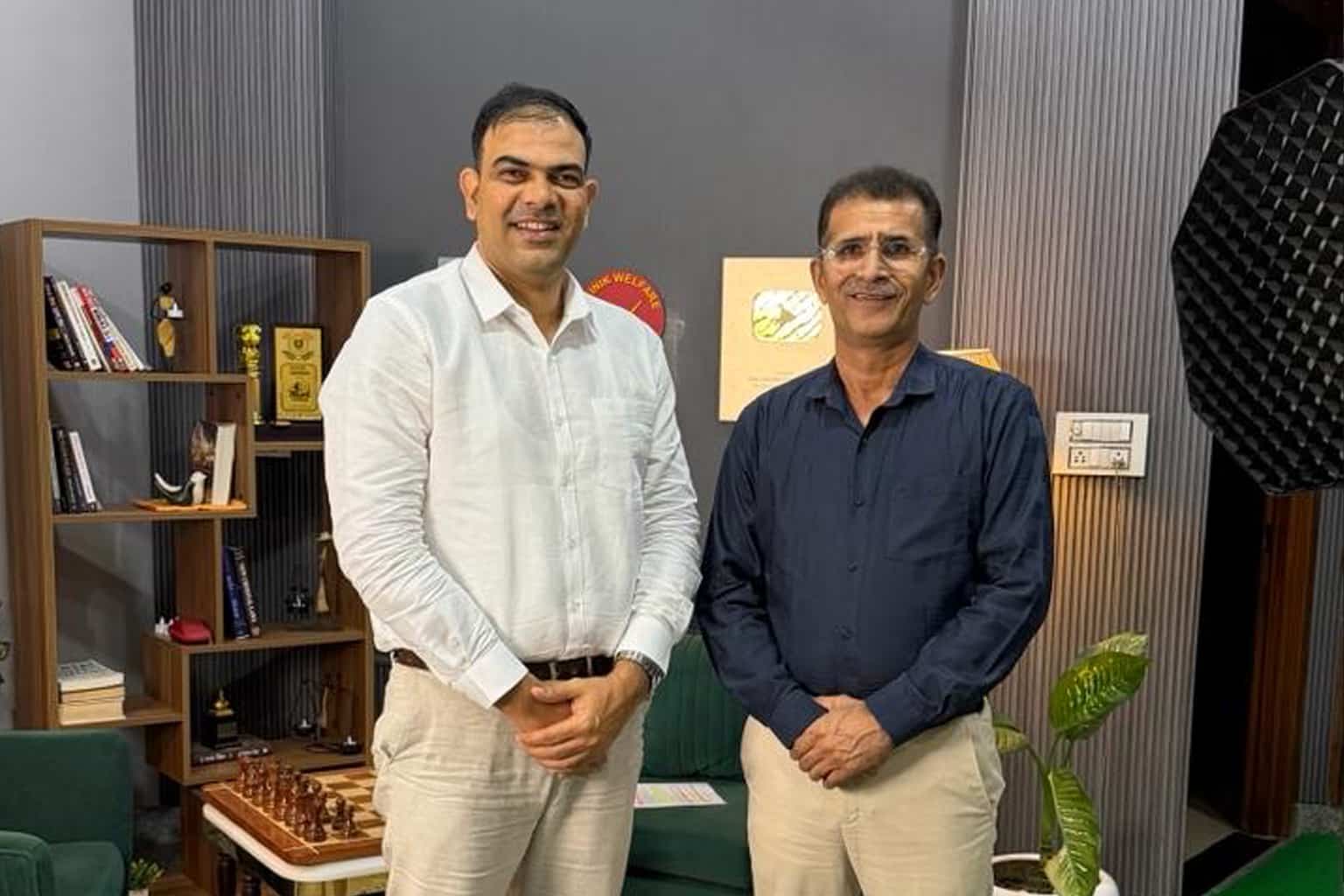
Many defence personnel retire with discipline, experience and leadership — but still struggle to explain their value to the civilian world.
The problem is not lack of capability.
The problem is translation.
A soldier, air warrior or sailor may have handled men, machines, operations, crisis, logistics, safety and responsibility for years. But when he enters the civilian job market, he is often asked to fit himself into narrow boxes — HR, admin, security, operations, facility management or logistics.
This is where many veterans make the mistake of underselling themselves.
In a detailed conversation with Sainik Welfare News, Wing Commander Vineet Kumar (Retd.) brought out a powerful truth: the Armed Forces make a person capable enough to do almost anything, but after retirement, that capability must be understood, focused and presented correctly.
Fauj gives capability, but civilian life demands clarity
One of the strongest points from the conversation was simple: the Armed Forces train a person to handle multiple responsibilities, but the civilian world does not always understand a “jack of all trades” profile.
In uniform, a person may manage men, stores, canteen, mess, transport, discipline, training, administration and operations. The system expects versatility.
But outside, the corporate world asks a sharper question:
What exactly do you want to do?
This is where serving personnel approaching retirement must start early. They must identify their strongest area before leaving service.
Are they best suited for operations?
Logistics?
Aviation?
Training?
Risk management?
Facility management?
Hospitality?
Supply chain?
Administration?
Corporate security?
Crisis response?
A veteran can do many things. But for a successful second career, he must not enter the market saying, “I can do everything.”
He must say, “This is my strongest professional value.”
Military experience is more than a uniformed past
Many civilians see defence service only through the lens of postings, ranks and uniforms. But military experience is much deeper.
A defence career teaches:
Planning under pressure
Decision-making with incomplete information
Team leadership
Resource management
Crisis handling
Accountability
Safety consciousness
Discipline
Time-bound execution
Respect for process
Mission focus
These are not ordinary skills.
These are exactly the qualities that companies spend years trying to build inside their teams.
The challenge is that veterans often do not express these qualities in corporate language.
For example, running a unit canteen is not a small internal duty. It is retail management under strict audit, limited resources, controlled timings and high accountability.
Managing a mess is not just hospitality. It is food service, vendor coordination, staff management, quality control, guest handling and 24-hour response.
Handling military supply is not only “stores work.” It is logistics, distribution, warehousing, route planning and supply chain execution in difficult conditions.
This is the language veterans must learn to use.
Zero-error operations: What corporate India can learn from the Armed Forces?
Wing Commander Vineet Kumar spoke about VVIP air operations and the preparation required behind them.
In such operations, there is no casual margin for error. Planning has to be detailed. Coordination has to be precise. Timings have to be respected. Civil agencies, military agencies, police and other security stakeholders may all be involved.
For one hour of flying, there can be hours of ground preparation.
This is not just aviation work. This is operational excellence.
Corporate India talks about process, risk mitigation, coordination and delivery. Defence personnel live these principles long before they use such corporate words.
A defence officer or JCO who has handled sensitive operations understands something very important: success is not built at the last moment. It is built in preparation.
That is a leadership lesson every organisation needs.

Disaster relief shows the human side of military training
The conversation also touched upon disaster relief operations during floods in Srinagar and Kerala.
Such operations are unpredictable. Water levels rise, roads disappear, communication breaks, people are stranded, weather changes and every decision has human consequences.
In Kerala, helicopters had to operate in difficult conditions. Coconut trees, flooded areas, damaged infrastructure and scattered distress calls made rescue work complex. Local fishermen, police, civil administration, Air Force, Navy and Army teams had to work together.
This shows the real strength of defence training.
Military personnel are not trained only to fight. They are trained to respond when systems are under pressure.
When people are trapped, when food has to be delivered, when injured citizens have to be evacuated, when stranded personnel are forgotten in remote pockets — the Armed Forces bring order into chaos.
This ability is extremely valuable after retirement.
Veterans understand crisis not as theory, but as lived experience.
The biggest mistake veterans make after retirement
Many defence personnel start thinking about their second career too late.
Some wait until the last few months. Some leave service and then begin searching randomly. Some send the same resume for every type of job. Some assume that rank alone will explain their capability.
It does not work that way.
The civilian world does not automatically understand military roles.
A company may not know what a unit adjutant does. It may not understand what a logistics officer has handled. It may not know the pressure of air operations, convoy management, aviation safety, mess administration, inventory audit or disaster response.
Therefore, the veteran must explain it.
The biggest mistake is not lack of experience.
The biggest mistake is failing to convert military experience into civilian relevance.
How defence personnel should prepare for second career?
A serving person nearing retirement should begin preparation early.
The first step is self-assessment.
What work did I perform best?
Which responsibilities gave me the strongest results?
What problems did I solve repeatedly?
Which industry can use my experience?
What civilian words match my military work?
What additional certification do I need?
Which network should I build before retirement?
A veteran should not wait for retirement day to ask these questions.
If possible, planning should begin at least one to two years before transition.
This does not mean every person must leave service. It means that those who are going to retire or seek premature release should not enter the civilian world unprepared.
Veterans must stop limiting themselves to security jobs
Security is a respectable and important field. Many veterans perform exceptionally well in it.
But every veteran does not have to restrict himself to security.
A soldier who managed supplies can enter logistics.
A technical officer can enter manufacturing or engineering support.
A pilot can enter aviation operations.
An education instructor can enter training and academic administration.
A mess manager can enter hospitality operations.
A canteen officer can enter retail operations.
A unit administrator can enter facility management.
A disaster relief coordinator can enter crisis management and business continuity.
The problem is not shortage of opportunities. The problem is often lack of mapping.
Veterans must map their service experience to civilian industries.
Why corporate India should look seriously at ex-servicemen?
Companies today need people who can handle pressure, work with integrity and deliver without constant supervision.
This is where ex-servicemen can bring tremendous value.
A veteran understands punctuality.
A veteran respects chain of responsibility.
A veteran can work with limited resources.
A veteran can lead mixed teams.
A veteran can take decisions in uncertain situations.
A veteran understands safety and accountability.
A veteran knows that excuses do not complete a mission.
Corporate India often spends heavily on leadership training. But many retired defence personnel already carry leadership experience from real situations.
They only need the right opportunity and the right role fit.
Military decision-making is a rare strength
One of the most important military lessons is decision-making with incomplete information.
In real operations, nobody waits until 100 percent information is available. A commander may have 70 or 80 percent information and still has to decide at the right time.
A late correct decision may fail.
A timely good decision may save lives.
This mindset is extremely useful in business.
Markets change. Supply chains fail. Teams face pressure. Customers demand quick responses. Projects face uncertainty. In such situations, a veteran’s ability to assess risk and act with discipline becomes valuable.
This is one reason why ex-servicemen can become strong operations leaders.
The Armed Forces also need better career communication
The conversation also raised an important point about youth awareness.
Many young people do not fully understand what a career in the Armed Forces can offer. They may know the words Army, Navy and Air Force, but they may not know the depth of opportunities inside them.
A student who wants to become a pilot may not know that flying opportunities exist in the Armed Forces.
A student interested in engineering may not understand the exposure defence technology can provide.
A young person may still carry old fears or incomplete information about military careers.
The Armed Forces are doing outreach, but the message needs to be sharper, wider and more modern.
Today’s youth need to hear not only about service, but also about skills, exposure, technology, aviation, engineering, leadership and future career pathways.
If the best talent has to enter the Armed Forces, the best talent must first understand what the Armed Forces truly offer.
Service does not end with uniform
The most important message from this conversation is larger than one career.
A person who has served in uniform carries something that cannot be written fully in a resume.
He carries discipline.
He carries resilience.
He carries the habit of responsibility.
He carries the ability to stand steady when others panic.
He carries a sense of duty.
These qualities do not retire.
After retirement, the uniform may be kept aside. The rank may become “Retd.” But the training remains.
The challenge is to use it in the right direction.
Final view
The second career of a defence person should not be treated as a compromise.
It should be treated as the next mission.
The Armed Forces prepare a person for much more than one appointment or one branch. They create people who can lead teams, manage pressure, handle crisis, protect resources and take responsibility when situations become difficult.
But every veteran must recognise his own real value.
Do not enter the civilian world confused.
Do not reduce your experience to one line.
Do not wait until retirement to prepare.
Do not assume that others will understand your military background automatically.
Translate your experience.
Choose your direction.
Build your profile.
Speak the language of the industry.
The country needs trained, disciplined and responsible people not only in uniform, but also outside it.
For ex-servicemen, the message is clear: your service has not ended. It has changed form.
Source Note
This article is based on a Sainik Welfare News podcast conversation with Wing Commander Vineet Kumar (Retd.) and is written as an original blog interpretation for public awareness, veteran transition and second-career guidance.
Sources:-
DGR — About Directorate General Resettlement
https://www.desw.gov.in/about-dgr
DGR official website
DGR Job Assistance page
https://dgrindia.gov.in/Content1/job-assistance
DGR Training page
https://dgrindia.gov.in/Content1/training
DGR Online Registration Process
https://dgrindia.gov.in/Content2/registration/online-registration-process
National Career Service
NCS Jobs for Ex-Servicemen
https://www.ncs.gov.in/jobs-for-ex-servicemen
PIB — Air Force Rescue Operation during Kerala Floods
https://www.pib.gov.in/PressReleaseIframePage.aspx?PRID=1562584
PIB — Indian Armed Forces in Humanitarian Assistance and Disaster Relief
https://www.pib.gov.in/PressReleasePage.aspx?PRID=2228319


Leave a Reply